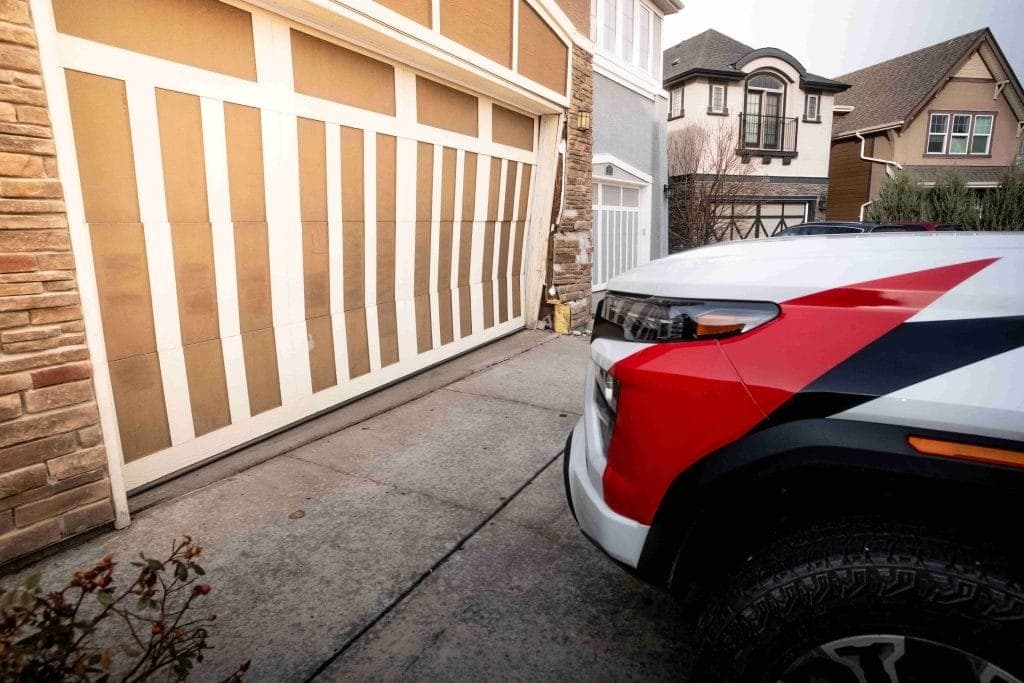
Saskatoon homeowners know the cold is brutal. What most don't realize is how specifically that cold — and the other climate factors unique to the Saskatchewan prairie — affect the mechanical system that is their garage door. It's not just "it gets cold and things break." The mechanisms are specific, predictable, and largely preventable if you know what to look for.
After serving Saskatoon homeowners and analyzing failure patterns across our three-province operation, here's what makes Saskatoon genuinely different — and what you can do about it.
Saskatoon's Climate by the Numbers
75°C
Annual temperature range (-40°C to +35°C)
103
Frosty days per year (avg)
20 km/h
Average winter wind speed
Low
Winter humidity (dry cold)
Four Climate Factors That Damage Saskatoon Garage Doors
1. Extreme Thermal Cycling — The 75°C Swing
Every component on your garage door is metal, rubber, or plastic. All three expand when warm and contract when cold. A 75°C annual swing means these materials cycle through more dimensional changes per year than almost any other major city in Canada.
For springs specifically, this is devastating. A torsion spring rated for 10,000 cycles at room temperature accumulates additional fatigue from thermal cycling that the manufacturer's rating doesn't account for. The spring doesn't know whether it's being stressed by lifting the door or by contracting in -40°C cold — the metal just fatigues.
Result: springs that should last 7–10 years by the book last 5–7 in Saskatoon. We price standard replacement at $380–$480 + TAX and recommend checking springs annually after year 3.
2. Dry Cold — The Seal Killer
Saskatoon's winter air is extremely dry. Relative humidity in January averages 70-75% outdoors but drops much lower inside heated garages. This dry environment pulls moisture from rubber weatherstripping and seals — literally desiccating them over time.
In Edmonton (which is also cold), the North Saskatchewan River adds humidity that keeps seals somewhat supple. In Saskatoon, there's no such buffer. EPDM rubber — the standard material for garage door weatherstripping — loses its plasticizers in dry cold, becoming brittle and cracking at the flex points.
The practical effect: weatherstripping that lasts 5–7 years in milder climates lasts 2–4 years in Saskatoon. When it fails, cold air infiltrates the garage, and the bottom seal freezes to the floor. Replacement: $220–$260 + TAX.
3. Prairie Wind — Invisible Lateral Stress
Saskatoon sits on open prairie. There are no mountains, no significant hills, no dense urban barriers to break the wind on the west and south sides of the city. Winter winds averaging 20 km/h (with gusts much higher) push against garage doors with a lateral force that residential doors aren't specifically designed to resist.
One windstorm doesn't do anything noticeable. But years of cumulative lateral pressure shifts track alignment incrementally, adds wear to rollers and hinges on the windward side, and can eventually cause binding or uneven door travel. South- and west-facing doors in exposed neighborhoods (Stonebridge, Brighton, Kensington, Evergreen) see this sooner than sheltered ones.
Windborne grit is the other factor. Prairie dust and sand particles accelerate wear on rollers and tracks — acting like fine sandpaper every time the door opens. Annual lubrication and roller inspection catches this before it becomes a replacement job.
4. No Thaw Cycle — The Sustained Assault
Calgary gets Chinook winds that spike temperatures by 20–30°C in hours — brutal on springs from the rapid swing, but they also break the freeze cycle. Ice melts. Lubricant flows again. Seals release from frozen floors. Edmonton is similar to Saskatoon in sustained cold, but its river valley provides slightly more humidity.
Saskatoon gets none of these reprieves. When -25°C arrives in late November, it stays. Week after week. Ice builds on the bottom seal and doesn't melt. Lubricant thickens and stays thick. Springs stay under maximum cold-contraction tension without any warm intervals to relieve stress.
This sustained stress pattern — not just cold, but relentless cold without breaks — is what makes Saskatoon arguably the hardest major city in Western Canada on garage door hardware. It's not the coldest day that does the damage. It's the hundredth consecutive cold day.
How to Protect Your Garage Door in Saskatoon
Switch to silicone lubricant in September — stays liquid to -40°C (replace any petroleum or lithium grease)
Inspect weatherstripping for cracks every fall — dry cold degrades it faster than you'd expect
Book annual maintenance ($120–$180 + TAX) — catching a $120 problem prevents a $480 emergency
Check door balance twice a year: disconnect opener, lift to halfway — if it drifts down, springs are weakening
Watch for binding on the windward side (usually south or west) — could be track alignment shifting from wind stress
Consider high-cycle springs (25,000 cycle, $680) if you plan to stay long-term — they outlast two standard spring sets

Stan and Marta Klugman
Founder & CEO, Garage Door Fix Inc.
Garage Door Fix has completed 32,000+ jobs since 2019.