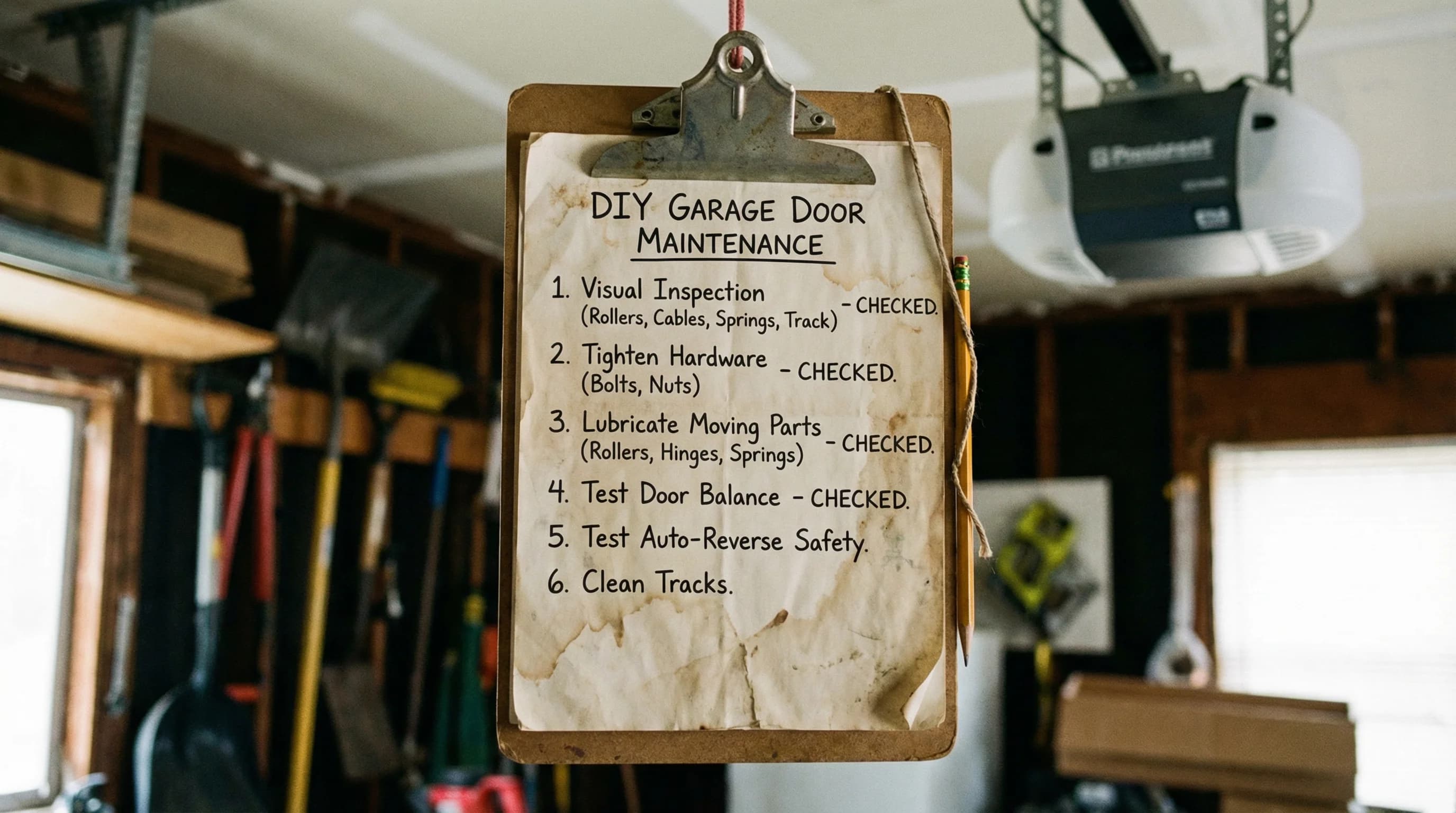
I'm going to do something most garage door companies won't: tell you what you can fix yourself. Not because I want fewer customers — we have 3,610+ five-star reviews across our company history and plenty of work — but because being honest about what doesn't need a professional builds the kind of trust that brings people back when something actually does.
The garage door industry has a bad habit of making everything sound dangerous to discourage DIY. That's partly self-serving and partly legitimate — some tasks really are dangerous. The trick is knowing which is which.
What You Can Safely Do Yourself
These tasks involve no high-tension components, no electrical risk, and no heavy lifting. A homeowner with basic tools can do all of them safely.
Lubricate springs, rollers, and hinges
Twice a yearSilicone spray on all metal moving parts. Twice a year — once in spring, once in fall. Takes 10 minutes. Costs $10 for a can of silicone spray.
Tighten loose hardware
Once a yearThe vibration from thousands of open/close cycles loosens bolts. A socket wrench and 15 minutes tightens everything — roller brackets, track bolts, and hinge screws.
Test and align safety sensors
Every few monthsThe sensors at the bottom of the door frame should have steady green lights. If blinking, clean the lenses with a cloth. If still blinking, adjust the brackets until they're aligned. Test by placing an object in the door's path — it should reverse.
Replace weatherstripping
Every 3–5 yearsUnscrew your old vinyl or steel side and top weatherstripping, cut the new piece to length if needed, then fasten it in place. This is a straightforward DIY job with basic hand tools.
Replace bottom seal
Every 3–5 yearsBottom seals are usually a DIY job too, but check the retainer first. If the seal slides into an existing retainer track, replacement is simple. If the retainer is bent, damaged, or missing, that part may need extra work before the new seal will fit properly.
Visual spring inspection
Monthly in winterLook at the springs above your door. Check for a gap between coils, rust, or visible wear. If there is a gap, the spring is broken, even if the door still works because the door is light or the opener is strong enough to lift it. Don't touch the springs — just inspect them visually and call a professional if you see any of these signs.
Test door balance
Twice a yearDisconnect the opener (pull the red emergency cord). Lift the door manually to the halfway point and let go. If it stays, the springs are balanced. If it drifts up or down, springs need adjustment — and that's a professional job.
Reprogram keypad or remotes
As neededKeypad and remote reprogramming is usually a safe DIY job. Find the Learn button on your opener, then follow the pairing steps for your brand. There are lots of YouTube videos that walk homeowners through it step by step.
What You Should Never Do Yourself
These tasks involve high-tension springs, cables under load, or heavy components that can cause serious injury if they fail mid-repair. Professional technicians have specialized tools and safety training for these specifically.
Spring replacement or adjustment
Torsion springs store enough energy to lift 200+ pounds. Adjusting winding cones with improper tools or technique can cause the spring to unwind violently. Emergency rooms see these injuries every year.
Cable replacement
Cables are under extreme tension when the door is closed. They can snap and whip with enough force to cause lacerations or eye injuries. Cable drums require specific tools and knowledge of winding direction.
Track realignment or replacement
The door weighs 150–300 pounds and is held in place by the tracks. Removing or adjusting a track with the door in place risks the door falling. This requires proper bracing and support equipment.
Opener electrical or internal component repair
Opener disassembly while connected to power risks electrical shock. The parts that usually fail are internal electrical components like the receiver, logic board, or limit switch, not the motor itself. Some opener components are also spring-loaded internally, which adds another layer of risk for DIY repair.
Bottom bracket replacement
The bottom brackets hold the cable attachment points. They're under the full tension of the cable system. Removing them without releasing the spring tension can release stored energy instantly.
The Math That Makes DIY Spring Replacement Irrational
I understand the impulse. Springs are available online for $60–$100 each, or about $120–$200 for a pair, if they measured them correctly. YouTube has step-by-step videos. The professional repair costs $380–$480. That gap looks like a savings opportunity.
But run the full calculation:
The savings are roughly $140–$235 if everything goes right. The downside if it goes wrong ranges from avoidable door damage to a hospital visit. That's not a favorable risk/reward.
The Simple Rule: If It's Under Tension, Call Us
Any component that stores or transfers force — springs, cables, bottom brackets, winding cones — is a professional job. Everything else (lubrication, sensors, weatherstripping, bottom seals, keypad or remote reprogramming, visual inspection) is fair game for a handy homeowner.
And if you're not sure whether something is under tension? It probably is. Call us at 1-888-777-6305 and we'll tell you honestly — even if the answer is "you can do that yourself."

Stan and Marta Klugman
Founder & CEO, Garage Door Fix Inc.
Garage Door Fix has completed 32,000+ jobs across its company history since 2019.