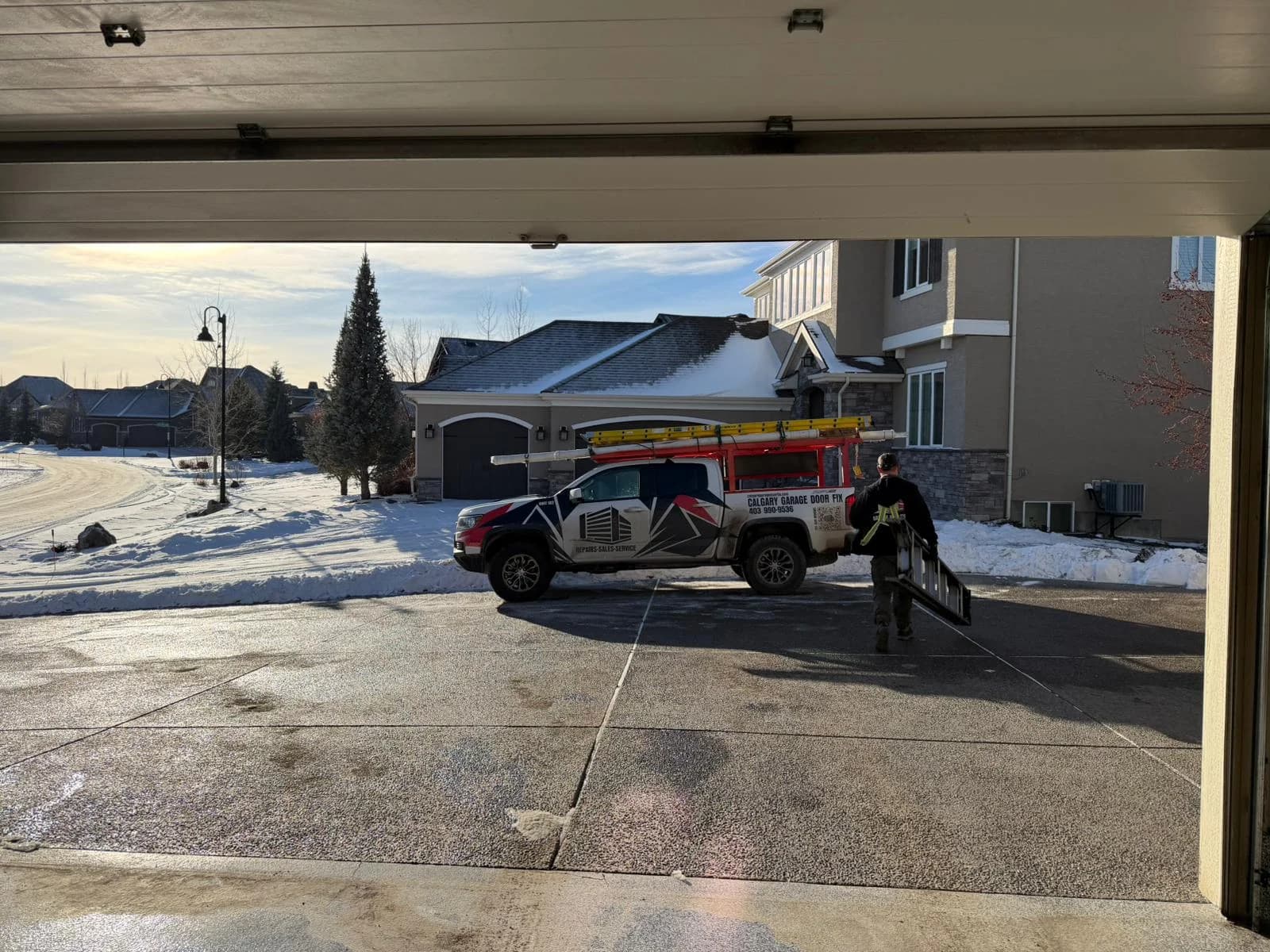
Here's something most homeowners don't know: when you call a garage door company in Canada, the person who shows up at your house might not work for that company. They might be an independent contractor — a freelancer — dispatched under the company's name but not employed, trained, or directly supervised by them.
This is more common than you'd think. It's how many garage door companies — including some well-known ones — scale their operations without the cost of hiring full-time staff. And while it's perfectly legal, it creates problems that most homeowners only discover after something goes wrong.
How the Subcontractor Model Works
A homeowner calls Company X. Company X takes the booking, charges the customer, and dispatches a technician. That technician, however, doesn't receive a paycheck from Company X. They're an independent operator — they have their own tools, their own vehicle (sometimes branded, sometimes not), and they get paid per job or per lead.
From the homeowner's perspective, it looks the same: someone shows up and fixes the door. The difference is in what happens behind the scenes — specifically around training, accountability, and warranty.
Subcontractor Model
- Technician is an independent operator
- May work for multiple companies
- Training standards vary by individual
- Company has limited control over work quality
- Warranty claim involves two parties
- Vehicle may or may not be branded
- Technician may not be known to the company beforehand
Employee Model (Ours)
- Technician is a company employee
- Works exclusively for Garage Door Fix
- Trained to company standards
- Company directly controls work quality
- Warranty is the company's responsibility — period
- Company vehicle and company uniform
- You know the technician's name before they arrive
Why Companies Use Subcontractors
I want to be fair here — there are legitimate business reasons to use subcontractors. Hiring employees is expensive. You need to pay benefits, WCB premiums, training costs, vehicle maintenance, and payroll even when call volume is low. Subcontractors convert that fixed cost into a variable one: you only pay when there's work.
For a startup or a company expanding into a new city, subcontractors make the economics work before there's enough volume to support full-time staff. I get it.
The problem is when companies stay on the subcontractor model long after they could afford to hire, because it's cheaper. And the further problem is when they don't tell customers. If you call "Calgary's Best Garage Door Company" and they send someone who works for three other companies too, you're not getting what you thought you were paying for.
The Warranty Gray Zone
This is where the subcontractor model hurts homeowners most. Say a subcontractor installs a spring, and six months later it fails. You call the company. The company says: "We'll send someone to look at it." They send a different subcontractor, because the original one doesn't work for them anymore.
The new tech looks at the job and says: "This wasn't installed correctly. That's not a warranty issue — that's a workmanship issue." Now you're in a dispute between the company (who says the subcontractor is responsible) and the subcontractor (who may be unreachable). The warranty that sounded good on paper has a structural gap.
With an employee model, there's one responsible party: the company. If our employee installed it, we warranty it. No finger-pointing, no gray zones, no "that was the contractor's fault." This is why our warranty terms are published on every service page — they mean what they say because we control every step.
How to Verify Before They Start
Ask on the phone: "Is the technician your employee?"
Not "is he one of your guys" — specifically "is he an employee of your company?" The word choice matters. "One of our guys" can mean a regular subcontractor. "Employee" has a legal meaning.
Ask: "Can you tell me the technician's name before they arrive?"
A company that employs its technicians knows exactly who's going to your house. A company dispatching from a subcontractor pool might not know until 30 minutes before.
Look at the vehicle
Company-branded trucks are expensive. Subcontractors usually drive personal vehicles — sometimes with a magnetic sign, sometimes with nothing. A branded vehicle isn't proof, but an unbranded one is a signal.
Check for a company uniform
Employees usually arrive in company uniform. Subcontractors may have a branded shirt, or they may show up in regular work clothes. If the branding is unclear, ask who they work for before letting them start.
Ask who handles the warranty
"If something goes wrong with this repair in six months, who do I call — you or the technician directly?" If the answer involves the word "contractor" or "partner," you know the structure.
Our Team — Named, Employed, Accountable
Every Garage Door Fix technician is a company employee. They're hired by us, trained by us, insured through us, and covered by WCB through us. When they show up at your house, they're in a company truck and company uniform.

Stan and Marta Klugman
Founder & CEO, Garage Door Fix Inc.
Garage Door Fix has completed 32,000+ jobs since 2019 — every one by a company employee.