A garage door spring is the counterbalance mechanism that makes a 150–300 pound garage door light enough for an opener (or a person) to lift. When springs work, you don't think about them. When they break, your door becomes a wall.
Spring replacement costs $380–$480 + GST for a standard pair in Calgary, Edmonton and Red Deer. The national average is similar. It's the most common garage door repair we do — roughly 60% of all service calls — and it's one of the few home repairs where you really shouldn't cut corners. Here's why, and everything else you need to know.
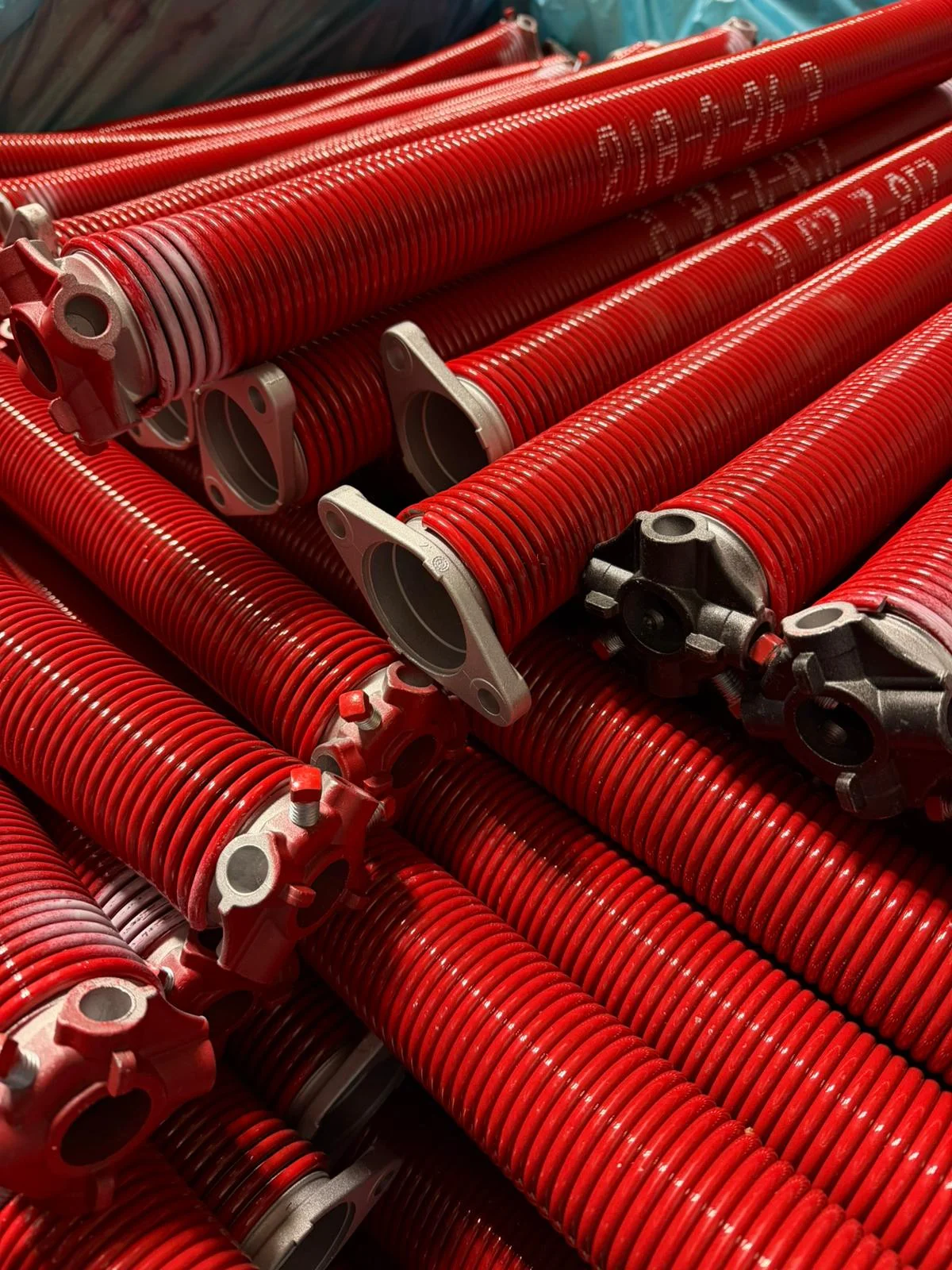
The Three Types of Garage Door Springs
Torsion Springs — What 90% of Modern Doors Use
Torsion springs mount horizontally on a metal shaft above your garage door. They store energy by twisting (torque) and release it to lift the door. When one breaks, you'll typically hear a loud bang — that's the stored energy releasing at once. The spring stays on the shaft, which is a safety advantage over extension springs.
Extension Springs — Older Homes and Budget Installations
Extension springs run along the horizontal tracks on either side of the door. They stretch (extend) to store energy and contract to lift. They're cheaper than torsion springs but less safe — when they break, they can fly off violently unless they have safety cables threaded through them. They were especially common in older homes with low headroom inside the garage, where a torsion shaft often would not fit above the door without a different track or hardware setup. If your home has extension springs without safety cables, get them added immediately.
Torquemaster Springs — Wayne Dalton's Enclosed System
Torquemaster springs are a proprietary Wayne Dalton design. The spring sits inside a steel tube above the door — you can't see it from outside. The upside is safety (fully enclosed). The downsides are cost (Wayne Dalton parts only, higher prices) and parts availability (not every company stocks them). The hidden-spring design creates another problem: many homeowners do not realize the spring has broken, especially if a stronger 3/4 horsepower opener still manages to lift the door for a while. When that happens, the opener can keep pulling a door that is no longer properly counterbalanced, which can damage the opener internals and even rip the operator bracket out of the top section, damaging the top panel itself. When a torquemaster system needs replacement, we usually recommend converting to standard torsion — better parts availability, more spring options, and lower long-term cost.
What Spring Replacement Actually Costs
Spring prices depend on wire gauge (thickness), which is determined by your door's weight. The industry uses a color-coding system. Here's what each size costs — these are our actual Calgary prices, and Edmonton and Saskatoon are identical:
| Spring Type | Price (+ tax) | Notes |
|---|---|---|
| Standard Pair (Yellow – .207 wire) | $380 + GST | Lightly or non-insulated doors |
| Standard Pair (.218, .225, .234, .243, .250) | $460 + GST | Most common |
| Standard Pair (Blue – .262 wire) | $480 + GST | Heavy doors with overlay |
| Heavy-Duty (.273 wire – Orange) | $580 + GST | Heavy custom doors |
| Heavy-Duty (.283 wire – Light Blue) | $680 + GST | Commercial-grade |
| Single Spring (on single-spring system) | $280 + GST | Includes warranty |
| Single Spring (on 3-spring system) | $320 + GST | Per spring |
| 3 Springs (on 3-spring system) | $780 + GST | $260 each |
| 4 Springs (on 4-spring system) | $1,040 + GST | $260 each |
| Premium Quality Springs (pair)* | $680 + GST | 5-year warranty |
| Torquemaster Conversion (Wayne Dalton) | $580 + GST | Full system conversion |
| Spring Clamp Installation (temporary) | $220 + GST | Incl. $80 deposit |
| Custom Spring Measurement | $120 + GST | $60 credit if ordered |
The Spring Color Code — What It Means for Your Price
Walk into your garage, look at the spring above the door, and check the color of the paint dot or stripe. That color tells you (and us) the wire gauge:
Yellow (.207 wire) — $380
Lightest springs — non-insulated or lightweight single doors
Red / Brown / Green (.218–.234) — $460
Mid-range — most common overall, standard insulated doors
Gold (.250 wire) — $460
High mid-range — heavier doors, most commonly older wooden garage doors
Blue (.262 wire) — $480
Heavy insulated double doors — the most common in Calgary and Edmonton
Orange (.273 wire) — $580
Heavy-duty — oversized or heavier custom residential doors
Light Blue (.283 wire) — $680
Extra-heavy springs — very heavy custom doors and some commercial-grade residential setups
The Cycle Rating Truth: 10,000 vs. 15,000+ Cycles
Every spring has a cycle rating — the number of open/close cycles it's designed to handle before it fails. A 10,000-cycle spring is the industry standard, and we install that option too. We also offer 15,000+ cycle upgrades with a 5-year warranty. Here's what that actually means:
10,000-Cycle (Standard)
- At 4 uses/day: ~7 years lifespan
- In cold climates: 5–7 years (thermal fatigue)
- Cost: $380–$480 per pair
- Industry standard option, not a cut-rate shortcut
15,000+ Cycle (Upgrade)
- At 4 uses/day: longer life than standard, depending on the spring spec installed
- Better fit for heavier-use households and long-term owners
- 5-year warranty on our upgrade option
- Higher upfront cost, lower replacement frequency
The real point is not that 10,000-cycle springs are "cheap junk." They are the industry baseline. The upgrade decision is about how long you plan to stay in the home, how often the door cycles, and whether you would rather pay once for a longer-lasting spring than replace a standard one sooner.
Signs Your Springs Are About to Fail
Springs don't always snap without warning. Here's what to watch for — if you notice any of these, it's time to call before the spring breaks on a -30°C morning:
The door feels heavier than it used to
Springs are losing tension. The opener compensates, but it's working harder and wearing out faster.
You hear squeaking or grinding from above the door
Metal fatigue creates friction as the spring coils rub against each other.
There's a visible gap in the spring coils
That usually means one spring is already broken. If the opener is still lifting the door, it is dangerous to keep operating it.
The door won't stay open at the halfway point
This is the balance test. If the door drifts down from halfway, springs are weak.
The opener reverses or struggles mid-cycle
The opener's safety system detects too much resistance — springs can't carry the load.
Why DIY Spring Replacement Is a Bad Idea
Safety Warning
A torsion spring on a standard two-car garage door stores enough energy to lift 200+ pounds. If the winding bar slips, the spring unwinds violently. Emergency rooms see garage door spring injuries every year — broken hands, facial lacerations, and worse. This is not a YouTube project.
I get it — there are videos online showing how to do it, and the springs themselves are available at hardware stores. But professional replacement costs $380–$480. Compare that to an ER visit, time off work, and the risk of damaging your door (which turns a $400 repair into a $3,000 door replacement). The math doesn't work for DIY.
What you can safely do: visually inspect springs for gaps or rust, lubricate springs with silicone spray twice a year, and test door balance by disconnecting the opener and lifting manually to the halfway point. If it drifts down, call us.
How Canadian Weather Kills Springs Faster
This is where our data gets interesting. Based on 32,000+ jobs across Calgary, Edmonton, and Saskatoon, springs in Western Canada fail 30–40% sooner than the national average. The reason is simple physics: metal expands when it's hot and contracts when it's cold. When that swing is 60–75°C annually (as it is in Alberta and Saskatchewan), springs accumulate fatigue cycles far faster than the manufacturer intended.
Calgary
Chinook winds cause 180–280% failure spikes. -30°C to +10°C in 24 hours is brutal on metal.
Edmonton
Long sub-zero stretches keep springs under steady cold stress, and many failures show up during or right after deep cold snaps.
Saskatoon
75°C annual range. Dry cold + prairie wind. 103 frosty days per year — more than any major Alberta city.
How Garage Door Fix Handles Spring Replacement

Stan and Marta Klugman
Founder & CEO, Garage Door Fix Inc.
Garage Door Fix has completed 32,000+ garage door jobs since 2019 across Calgary, Edmonton, and Saskatoon.