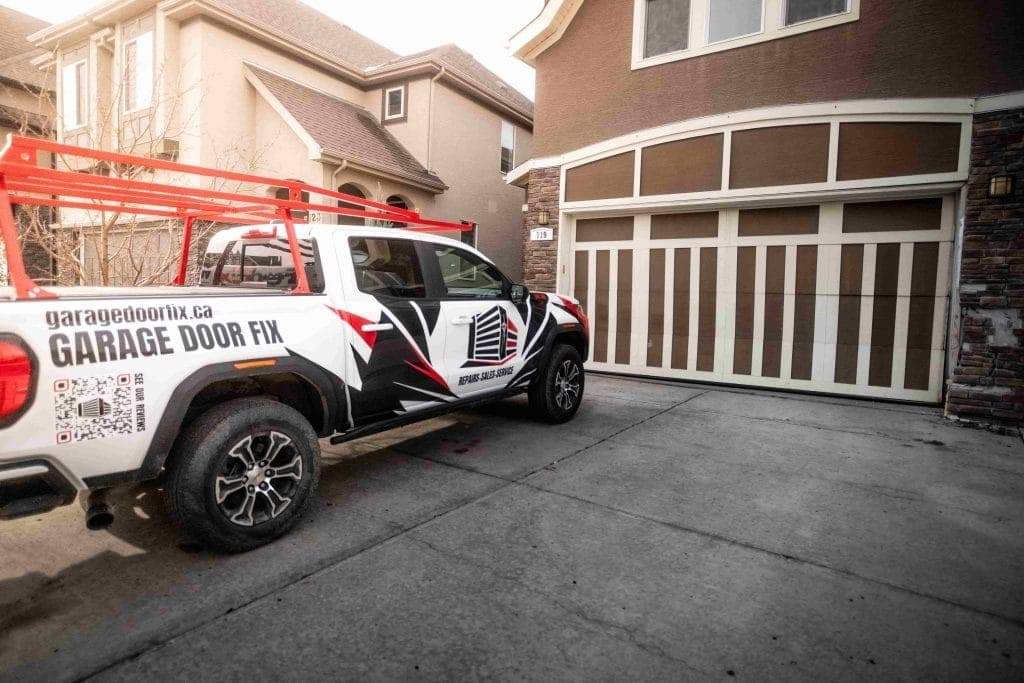
You moved into a new home in Windermere, Summerside, or one of Edmonton's south-side developments. Everything is new. Everything works. The garage door opens and closes without a sound. You don't think about it.
Three years later, you'll think about it. That's when the springs that came with the house — the cheapest springs the builder could install that still met code — will start to fail. This isn't a design flaw. It's economics. Builders optimize for inspection day, not for year five in Edmonton's climate.
What Builders Actually Install — And Why
When a builder prices a home, the garage door is a line item. Not a selling feature — a cost to minimize. Here's what that typically means for a new Edmonton home:
Springs
What the builder installs: 10,000-cycle minimum (cheapest that meets code)
Edmonton reality: In Edmonton's climate: 3–5 year lifespan instead of the rated 7 years
Insulation
What the builder installs: R-8 to R-12 (polystyrene — the white beadboard stuff)
Edmonton reality: Adequate for code, but R-16+ polyurethane performs significantly better at -40°C
Weatherstripping
What the builder installs: Minimum-thickness rubber seals, often black EPDM
Edmonton reality: Cracks and loses flexibility in Edmonton's dry cold within 2–3 years
Rollers
What the builder installs: Standard nylon or steel rollers
Edmonton reality: Steel rollers seize in extreme cold. Nylon survives better but builder-grade nylon is thin
Opener
What the builder installs: Basic chain drive (Chamberlain or house-brand)
Edmonton reality: Functional but loud, no battery backup, shorter lifespan than LiftMaster commercial-grade
None of this is the builder cutting corners illegally. It's the builder meeting code at the lowest cost. The problem is that Alberta building code doesn't account for the difference between Edmonton at -38°C and Vancouver at +2°C. The same minimum spec that works for 15 years in the Fraser Valley lasts half that long on the prairies.
The Edmonton New-Home Garage Door Timeline
Based on our service records from Edmonton's new developments, here's a rough timeline of when things typically need attention:
Everything works. Enjoy it.
Book a maintenance service at the 2-year mark — catching early wear is cheaper than waiting for failure.
Weatherstripping starts to crack or shrink. You notice cold air or daylight at the bottom or sides of the door.
Replace weatherstripping: $220–$260 + GST. Also inspect bottom seal.
Springs start to weaken. Door feels heavier. Opener works harder. One morning, a loud bang — spring broke.
Replace both springs: $380–$480 + GST. Don't replace just the broken one.
Rollers get noisy or bind in extreme cold. Track may show signs of frost heave misalignment.
Roller replacement: $220 + GST for all. Track check included with maintenance.
Opener struggles, especially in deep cold. Chain drives get louder. Battery backup (if any) stops holding charge.
Evaluate: repair ($180–$280) or upgrade to LiftMaster belt drive ($1,080+) with camera and battery backup.
Panels show wear. Insulation has degraded. Door is functional but underperforming.
Decision time: keep maintaining, or upgrade to a properly insulated door with high-cycle springs.
Edmonton Developments We Service Most for Builder-Grade Issues
Windermere / Windermere South
Built 2015–2022
Common issues: Spring failures, weatherstrip cracking, frost heave
Summerside / Ellerslie
Built 2012–2020
Common issues: Springs (5+ years old now), roller binding, opener strain
Rutherford / Callaghan
Built 2014–2021
Common issues: Weatherstrip degradation, first spring replacements starting
Heritage Valley / Chappelle
Built 2018–2024
Common issues: Early weatherstrip issues, occasional frost heave on new slabs
Desrochers / Cavanagh
Built 2020–2025
Common issues: Still in warranty period for most — maintenance recommended at year 2
Cy Becker / Crystallina Nera
Built 2016–2022
Common issues: NE exposure + builder-grade = accelerated weatherstrip and spring wear
What to Do Right Now

Stan and Marta Klugman
Founder & CEO, Garage Door Fix Inc.
Garage Door Fix has completed 32,000+ jobs since 2019.